Filming during the pandemic took a new twist when we were asked to film carolers four days before Christmas. But everything quickly fell into place. Mostly because the vocalists were pros led by an experienced conductor. And especially the audio part (by a separate crew) on an Atlanta street with a surprising amount of traffic… and leaf blowers… one block over. It’s always amazing to me what two guys (myself and colleague Joe Boris) can produce when you have four cameras going (his Canon and my Panasonic GH5 & GH4 and gopro7). And then spend about 15 hours on editing — on an extremely limited budget — so everything rolls out on Christmas Eve.
Step Ahead Scholars with Kon Kon
Here’s a project we started before the Covid19 shutdown in March as part of a Georgia Seminar workshop with the support of Georgia Humanities and Emory's Fox Center for Humanistic Inquiry.
Workshop participants helped with the interview and editing process. We planned to interview more of the Clarkston students, high school and college, but then went into shutdown.
Fortunately, we were able to meet with Kon Kon (then an Emory junior) and observe some classroom interactions at Clarkston High School led by the dynamic Mrs. Debra Nealy.
from https://www.stepaheadscholars.org:
Step Ahead Scholars began organically, as a college prep workshop in response to inequality that black and brown students face in under-resourced schools. It quickly became a go-to college access initiative as students and families realized it provided access to information, resources, skill sets and strategies needed for successful college transitions. In 2010, Kamal Carter, an Atlanta public school teacher, in response to students facing educational disparity and unequal opportunities, created Lunch With a Mentor, a volunteer mentoring program that offered students real world life experiences. Debra Nealy, a college access and equity advocate, volunteered. When one senior asked for help, she successfully guided them through the process and began developing the Step Ahead Scholars To and Through College model. Together, Kamal and Debra with the help of volunteers, are bridging the equity divide.

Documentary on Common Good Atlanta Goes into Post-Production & Crowdfunding
UPDATED DECEMBER 31, 2020: Thanks to 69 donors, we raised $8,727 (total goal - $18,500), which will go a long way towards paying musicians and other artists involved in producing a full-length documentary.
from our GoFundMe crowdfunder (Nov. 19, 2020)
https://www.gofundme.com/f/common-good-atlanta-documentary
Hi there… My name is Hal Jacobs and I wanted to tell you about our new documentary project on Common Good Atlanta.
It’s a program that connects incarcerated students with liberal arts professors in the Atlanta area.
Sarah Higinbotham founded it 12 years ago in 2008. Two years after that she was joined by local indie musician phenom Bill Taft, while they were both students (PhD & MFA, respectively) at Georgia State University.
It started with a simple idea. Bring books into the prison and teach the same kind of class you would teach at Georgia State, Georgia Tech, UGA, or Emory. Don’t hold anything back. Bring in writing tutors. Bring in students from area colleges to discuss books and ideas with the incarcerated students. Write poetry. Read primary sources. Discuss critically. Write. Write. Write some more.
The program has grown to over 100 faculty from area universities with a waiting list. Hundreds of students have participated in classes. A growing number of these alumni are back in their communities seeing the world through different eyes, spreading the word.
One of the alumni, Janine Solursh, is a co-writer with me on her first documentary project.
We want to tell the story of this innovative program because it deserves a wider audience.
Here we have two very different communities — the academics connecting with the incarcerated — listening to each other and learning from each other — creating a stronger community together.
Of course, it's also hard work. Sarah and Bill go hard at it every day. It’s hard for these students in prison. It’s still hard after they get released.
Last year Common Good Atlanta received the Governor’s Award in Georgia. And they were finalists in the Civvies, a national contest recognizing social-justice community groups.
Last year my son and I produced and directed the documentary on Lillian Smith, “Breaking the Silence.” In our crowdfunding, a lot of people helped us with contributions, large and small, and without them we couldn’t have made the kind of film we wanted.
That film has won several festival awards, it’s being shown in a lot of classrooms, libraries and social-justice groups.
We think this new film project has the same potential. And we’re asking for support to cover some of the help that’s needed (see below), while we volunteer our time and equipment to do everything else.
I hope you’ll check out the rough cut of our trailer to learn more. We’d love to recognize your contribution in the film’s credits — and look forward to sharing the final film with you in fall 2021.
Thanks in advance for your help.
Your contribution helps with:
-- Co-writing
-- Soundtrack by area musicians
-- Final editing
-- Final color & audio correction
-- Graphics
-- Festivals
See trailer: https://vimeo.com/481336885
"Vote YES on 1" (Ballot Amendment 1 Videos)
A few months ago we were asked to produce a series of videos informing the public about the importance of voting for the Trust Fund Honesty Amendment. So we reached out to several leaders in the community who’ve been involved with cleaning up the environment — Jacqueline Echols (South River), Mark Wilson (Yellow River), and Hattie Portis-Jones (Fairburn Councilmember) — and met up with them at some locations in need of a cleanup.
We also drafted some friends (and a friendly wife) to add their voices to a 30-second overview (see above).
You can find all the videos here: https://vimeo.com/showcase/7704208
And more info here: http://trustfundhonesty.org/resources/
Awards for "Breaking the Silence" Documentary
It was a great honor to have our documentary “Lillian Smith: Breaking the Silence” receive the best full-length documentary award at the 2020 Morehouse College Human Rights Film Festival. One of our first interviewees for the film was Lonnie King, a Morehouse alum and Atlanta Student Movement leader. We talked to him in fall 2017 (he died in spring 2019 before the film was finished), and he spoke very movingly about how important Lillian Smith’s voice was to him in the early 1960s. His interview gave us a much deeper understanding of her role in the struggle for human rights and social justice in the South — and the role that whites have in that struggle.
In August, “Breaking the Silence” was awarded “Best Georgia Made” at the Macon Film Festival. The film was also selected earlier in the year by the South Georgia Film Festival — and has been screened publicly or virtually by nearly 50 public libraries, and college, church and social justice groups.
Just as important are the talk-backs. The number-one question being: Why haven’t we heard about her before? Why are the voices of those white demagogues so familiar, but hers isn’t? She felt that she was being silenced in the South by the powers-that-be, but we discovered how many people she inspired behind the scenes, from the girls at her camp to openminded college students in the 1950s and ‘60s, Freedom Riders, and men like Lonnie King, John Lewis, and Dr. Martin Luther King, Jr.
It’s been quite an honor to share her words and vision with others. To bring her back into the conversation that we should all be having with others and ourselves.


Hambidge Artist Residency
Will be breathing that mountain air in August thanks to an artist residency offered by the Hambidge Center for Creative Arts and Sciences.
This creative sanctuary of 600 acres in the mountains of north Georgia began in the mid-1930s thanks to one enterprising and relentless woman, Mary Crovatt Hambidge, who lived the bohemian life of NYC in the 1920s and ten years later was ready to settle down to the life of a mountain weaver. She ended up being recognized internationally for the excellence of her weaving, and with the help of nearby women, started a cottage industry (The Weavers of Rabun) that sold its high-quality weaving at Rabun Studios in Manhattan.
If you want to know more about her story, check out my short film (Mary Crovatt Hambidge: Whistler, Wanderer, Weaver, Utopian; 2016).
During this artist residency I’ll be working on two new projects. One looks at Georgia artist Michael Murrell, who I first met while researching the Hambidge film. Murrell has created a fantastic body of work over the last 30 years that is hard to describe because it crosses so many boundaries and materials. You have to see it to believe it. (See a short video here I did a few years ago featuring his homage to the chestnut tree.)
The other project involves Common Good Atlanta, a boundary-crossing program in itself that brings together Georgia professors with incarcerated students to do a deep dive in the liberal arts. The program was started 12 years by Sarah Higinbotham, who was working on her PhD at Georgia State Univ. at the time (she’s now at Emory’s Oxford College) and was soon joined by Bill Taft, who was in the GSU creative writing program (he’s also a well-known Atlanta musician). Since then, they’ve created a nationally recognized program that has a waiting list of faculty wanting to teach in prison classrooms as well as a new program for released inmates. You see the true power of the liberal arts in liberating minds, both students and instructors, in this program.
So… lots of video editing ahead… along with that mountain air and gravel roads.
Thanks, Hambidge Center.
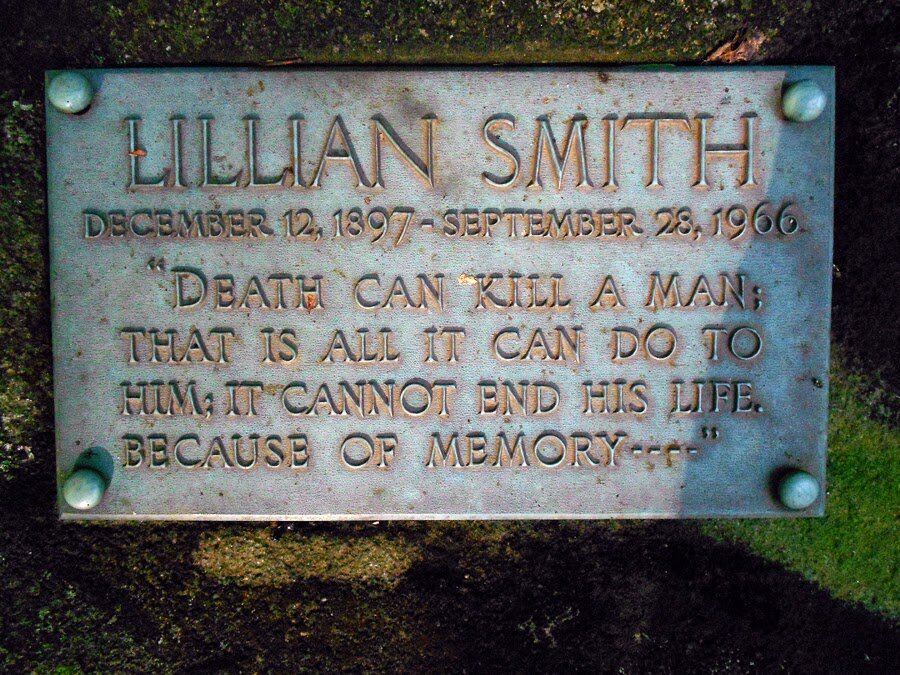
Virtual Screenings of "Breaking the Silence"
Lillian Smith, a white southerner, was shunned and threatened for most of her life for speaking out against white supremacy and its toxic effects on individuals and society.
In the last few weeks, people are putting their bodies on the line — once again — to protest police brutality aimed at people of color and the indifference of government officials.
As we begin hosting virtual screenings of our “Breaking the Silence” documentary, we hope to spark more dialogue and action based on Lillian Smith’s life and legacy.
We’ll also be available for zoom Q&As for groups/organizations.
We think Lillian Smith still has a lot to say about what’s going on.

Planning through the Pandemic
It’s the second week of our social distancing / home stay without any end in sight or answers about how long this pandemic will go on — or how bad it will turn out. And we’re thankful that family and friends are safe and healthy. And that we have a chance to stay busy with work. A new film festival in our hometown of Decatur that we’ll be organizing and curating. Planning underway for 5 hours of screening that begins Sunday, May 17th, and goes through Thursday. With a focus on arts in the community and throughout the South. And with some great filmmakers sharing their work (for details see https://decaturshortdocs.com/). It’s been a few years since we ran a film festival in Avondale Estates. And this one promises to be bigger and better with the support of Georgia Center for the Book and the Decatur Arts Festival.
What else? A couple of indie film projects that needs lots of editing and TLC over the next couple of months — many many hours of footage and interviews and archival material already gathered.
And at least six postponements of our “Breaking the Silence” documentary to be rescheduled in the summer and fall.
We’re lucky. We know it. We hope to get through this and see everyone on the other side.
-Hal
Fall 2019 Update
Fall 2019 has seen us screening our documentary on Lillian Smith at different venues (14 screenings so far) and beginning production on a film about the impressive education work of Common Good Atlanta (CGA). In 2015 we did a few interviews with instructors. Now we’re looking at the program in more depth, speaking with former incarcerated students who began taking classes while in prison, some of whom are continuing. Our film will be about the passion of everyone involved — students, volunteer instructors and program leaders Sarah Higinbotham and Bill Taft — and hopeful signs from the prison system that is paying more attention to returning citizens to their communities so they can make positive contributions.
Looking back to spring 2018, we made an informational video for West Georgia Hospice in LaGrange, Ga., which you can find here. We want to thank everyone involved in the filming, both the staff and families, for sharing their time and stories.
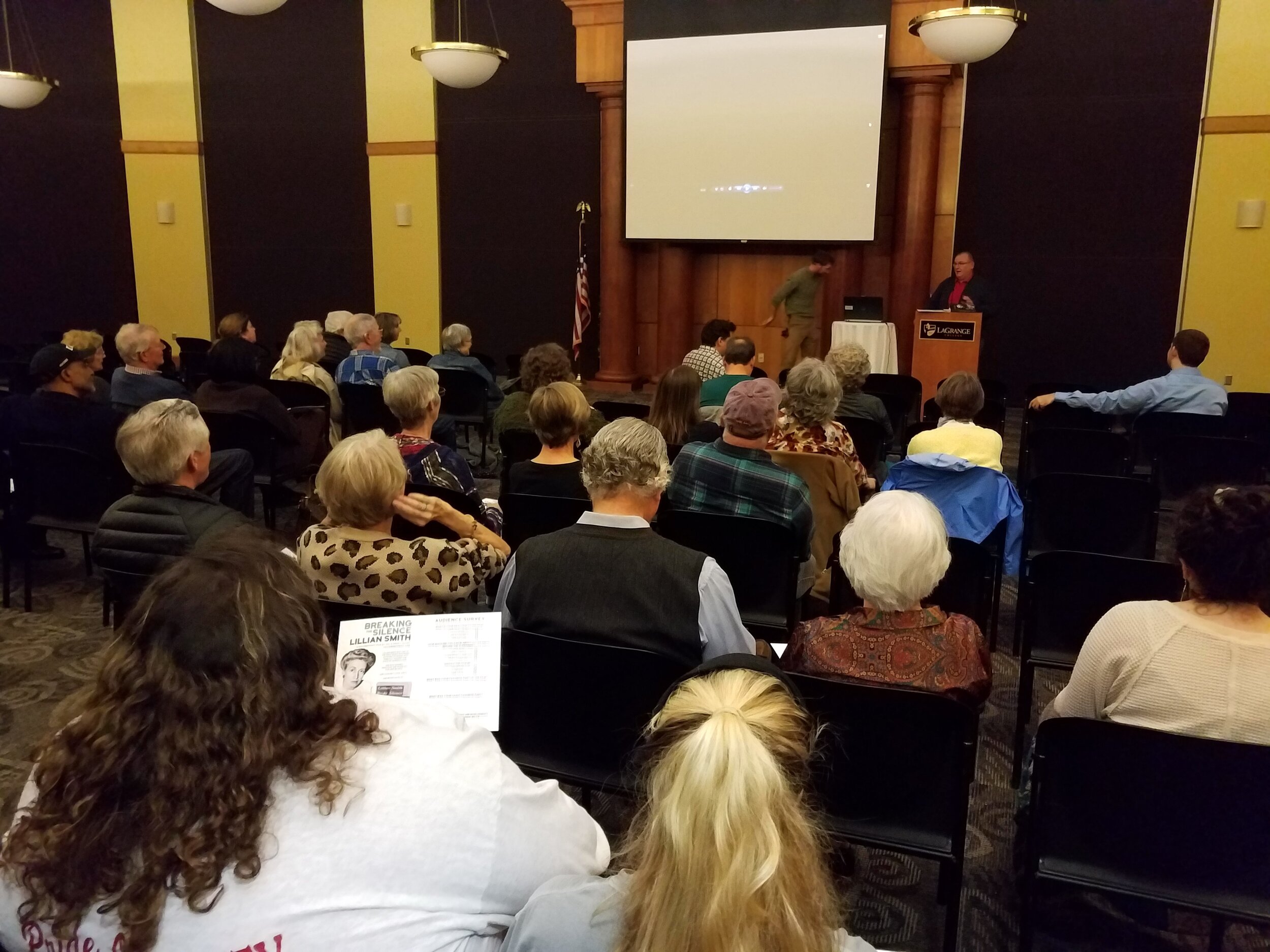

[Top image: LaGrange College screening of “Breaking the Silence.” Bottom image: Tariq Baiyini of Common Good Atlanta introduces the group at the Governors’ Award Ceremony at the state capitol.]
Summer Break 2019
A summer break in Chiang Mai, Thailand, visiting family. A month-long break from computer screens and cell phone beeps. And headlines. Also a month of scooters, temples, hot pavement, street food, circulating fans, beer with ice, and singing birds in cages. Now back to work, scheduling screenings of “Breaking the Silence” and sharing the words of Lillian Smith.
Carlos Museum Centennial Video
HJacobs Creative produced this short video to celebrate 100 years of the Carlos Museum of Emory University. It’s a small jewel of a museum and we’ve enjoyed countless visits there to the galleries and talks, so it was a great pleasure to bring the cameras in and listen to the stories of what makes it so special.
Premiere of Lillian Smith Documentary
It was extremely gratifying to quickly get two “sell outs” for our first preview screenings of “Lillian Smith: Breaking the Silence” at the Decatur Library (that’s Decatur, Ga.) on May 16-17 (a third sell-out screening was added on May 19th). Credit goes to our bookish Decatur community, of course, and the sponsorship/promotion by Georgia Center for the Book.
We’re finding out that there’s a Lillian Smith cult out there. Some people have been moved by her work in life-transforming ways. And this film is bringing people together in yet another way to celebrate the life and work of this nearly forgotten southern writer/activist.
We’re building on the work of others — Dr. Rose Gladney, who has spent decades researching and editing the work of Smith; Dr. Lisa Hodgens who co-edited with Gladney that fine compilation of Smith’s work and letters, “A Lillian Smith Reader” (UGA Press, 2017); Brenda Bynum, who wrote/performed/toured her one-woman show, "Jordan Is So Chilly: An Encounter with Lillian Smith"; and others who have written about and taught Smith in their classes.
We’re very fortunate to share their voices in this documentary.
And fortunate to have the support of nearly 100 people for our fall 2018 crowdfunder.
Along with the support of the Lillian E. Smith Center of Piedmont College, Georgia Humanities, the Watson-Brown Foundation, and the GSU Center for Neighborhood and Metropolitan Studies.
We look forward to getting a lot of feedback during these May screenings. And then we’ll finalize everything over the summer and gear up for fall 2019 and spring 2020 screenings.

"Accidental Stone Mason" Earns Award of Excellence at Film Festival
A few years ago a friend was talking about her brother, an oncologist and researcher in Knoxville, who was unearthing small boulders on his property that resembled Henry Moore statues. He had also spent the last 45 years building walls and pathways across his nearly 20-acre property. As someone who appreciates pushing big rocks around on my less than one-acre in-town plot, I wanted to see for myself. A few visits later, with the help of my son, Henry, and photographer Joe Boris, and of course the “accidental stone mason” Alan Solomon, we produced a short film to commemorate his work. Happily, months later, the University of Tennessee - Knoxville came along to make sure the work will be preserved and the property used as a resource for students. We also owe thanks to the Southern Shorts Film Festival for screening the film at its January 2019 festival and recognizing it with an award of excellence.
Telling "Clean 13" Stories
We’re happy to be documenting the stories of the “Clean 13,” a project by the Georgia Water Coalition to highlight the extraordinary efforts on the part of businesses, industries, local governments, non-profit organizations, and individuals to protect the water and natural resources of Georgia.
Thirteen videos, about 90 seconds each, premiered at the Clean 13 Celebration event in March 2019 to honor the winners and are now online (see the videos).


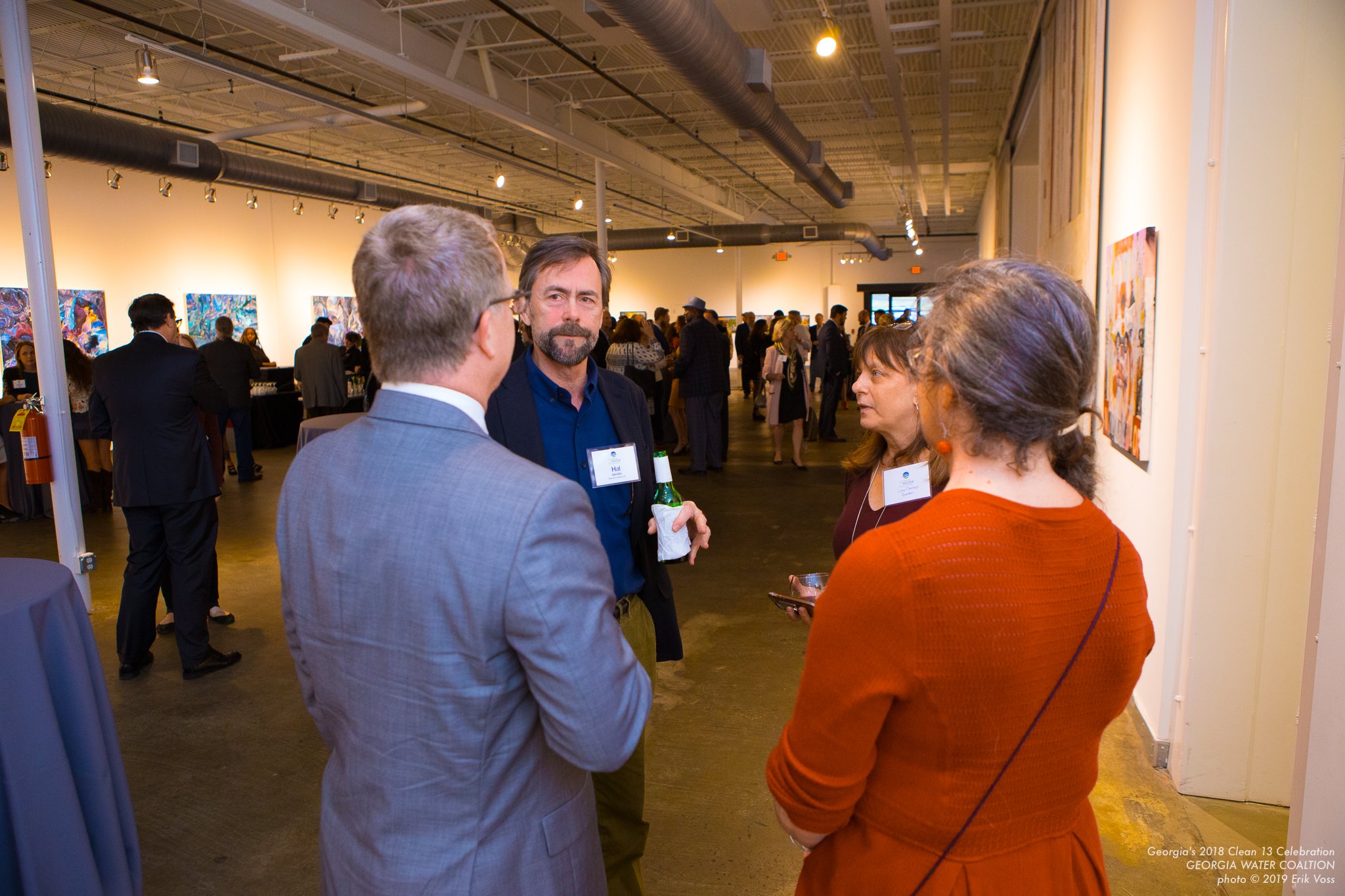
I think we were talking about our experiences of coaching youth baseball. Hence the serious demeanor.

Artsatl.com Looks at Lillian Smith Documentary
Just received a great holiday gift — the first writeup about the forthcoming Lillian Smith documentary from Atlanta artist/writer Donna Mintz. She and I sat down at my computer to look at a very very rough cut, and she captured the essence of what we’re trying to say in our narrative. Smith’s writings certainly stand on their own. But when you see her work in the context of her life, it can’t help but deepen one’s respect and appreciation for what she did.

Honoring the American Chestnut Tree
When Atlanta artist Michael Murrell told me of his project of digging up the massive stump of an ancient chestnut tree that he found in the national forest (he got permission) — and that he recorded much of it with a shaky camcorder — I thought of his work as performance art. So we put together his shaky footage with a brief interview in his studio to make this short film that honors the past — and future — of this beloved tree.
Talking about Documentaries
Emory’s Fox Center for the humanities has invited me to talk about the “new era” of documentary filmmaking, which to me means more diverse viewpoints, more distribution outlets, technological innovations that put more equipment into more hands, and more narrative techniques that allow filmmakers to tell their stories better. I’m especially talking up short documentaries because it frees up the filmmaker to be more creative instead of spending way too much time figuring out how to pad out a story into a 60- or 90-minute time block for mass media.

Highlighting a Stream Monitoring Program
Met a lot of dedicated volunteers and staff members while working on this video to promote Chattahoochee Riverkeeper's Neighborhood Water Watch program. You can learn more about the program here.
It was also my visit to Cascade Springs Nature Preserve (backdrop below). What a spectacular little park.

Documenting the Mechanical Riverfront Kingdom
Many Atlantans who live in the north DeKalb area know about it, but few have ventured off busy four-lane North Druid Hills Road (3162 N. Druid Hills Road, to be precise) to check out the best and brightest -- and only -- sculpture garden open to the public for many stop-and-go and soul-less miles around.
It's that "yard with the metal sculptures" to thousands of daily commuters and school children on yellow buses.
But spend a minute with artist Clark Ashton and you'll learn a thing or three. It's "The Commuter Gallery," begun almost 30 years ago. It's "The Mechanical Riverfront Kingdom," which includes "Faith in Industry," the "Control Tower," the "Sky Saw," the "Sky Stitcher," "The Infrastructure of an Uncertain Future," the "Bateman 5000," all situated on "Druid Hill" (a place name he hopes to make official soon with the U.S. Board on Geographic Names).
In his own words (something he is very good at in terms of describing his creative expression) he is "an artist with a keen sense of craft, a philosopher with a vision driven by self-actualization, free expression and independent thought, and a citizen with a responsibility to document our time as honestly as I am able.”
With the help of photographer/filmmaker Joe Boris, we've started talking to Clark and learning more about his work for an upcoming documentary.
In the meantime, you can find out more about Clark here:


As a big fan of the nonprofit world, I was happy to work on this project with folks at the Georgia Center for Nonprofits, especially Betsy Reid, who has such a keen eye for detail. The video, which landed here, is being used to promote an ebook on best practices in the nonprofit sector.